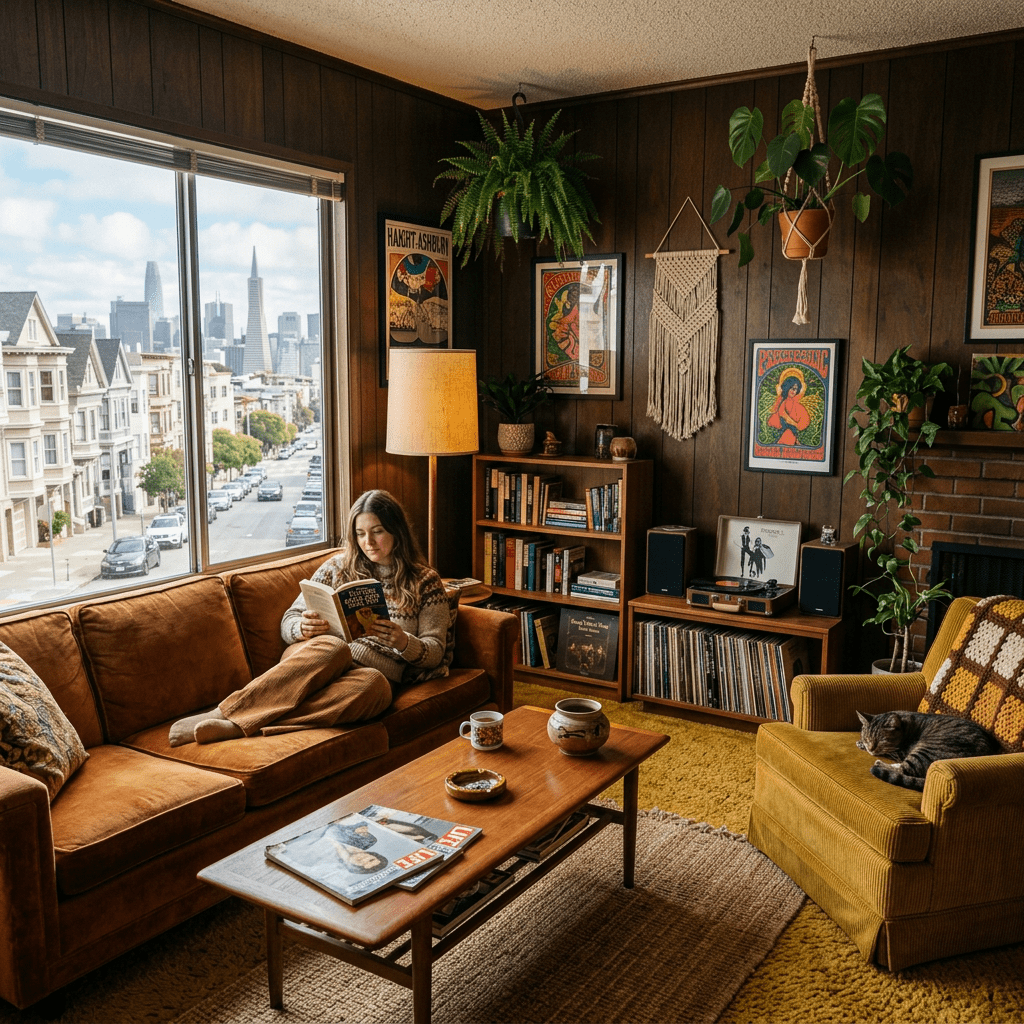
Armistead Maupin’s Tales of the City is the first in a series of ten novels (the series is also referred to as Tales of the City) chronicling the lives of a group of friends in San Francisco from the 1970s into the 1990s. The first five books were originally published in serial form in San Francisco newspapers; the remaining five were written as novels.
The stories revolve around the residents of an apartment house at 28 Barbary Lane: naive transplant from Cleveland Mary Ann Singleton, sweet gay Michael “Mouse” Toliver, bisexual hippie Mona Ramsey, ex-lawyer Brian Hawkins, and the mysterious landlady Anna Madrigal, who grows marijuana in the courtyard and welcomes new tenants with a joint.
Following this core group and their overlapping circles of friends, lovers, and employers, Maupin explores issues of gender, sexuality, race, class, and family (chosen and otherwise). And there’s a mystery to be solved involving the creepy tenant in the rooftop apartment. And that’s just the first book.
Subsequent books reflected current events, particularly the AIDS crisis, and referred obliquely to real people including Elizabeth Taylor and Rock Hudson. After the sixth book, Maupin took a two-decade break from Barbary Lane and then picked up where he left off with four more books before retiring the series.
The first novel was adapted as a television miniseries starring Laura Linney as Mary Ann and Olympia Dukakis as Mrs. Madrigal by BBC Channel 4 in 1993 and broadcast in the US by PBS. The second and third books, More Tales of the City and Further Tales of the City, were later adapted by Showtime. Linney and Dukakis appeared in all three, as well as a subsequent Netflix debacle; many of the other roles were recast.
Netflix produced a fourth series in 2019 and fucked it all up. They brought the story forward 40 years but only aged the returning characters (Mary Ann, Brian, Michael, Mrs. Madrigal) twenty years and invented a handful of new characters. If they had just taken the concept and created brand new stories around present-day residents of 28 Barbary Lane, or just used the wealth of material available and had it take place in the 90’s, it could have been great. But they tried to have it both ways and the result was pretty awful.
Read the books. Watch the first three series. Skip the last one.


Leave a comment